Facility Description
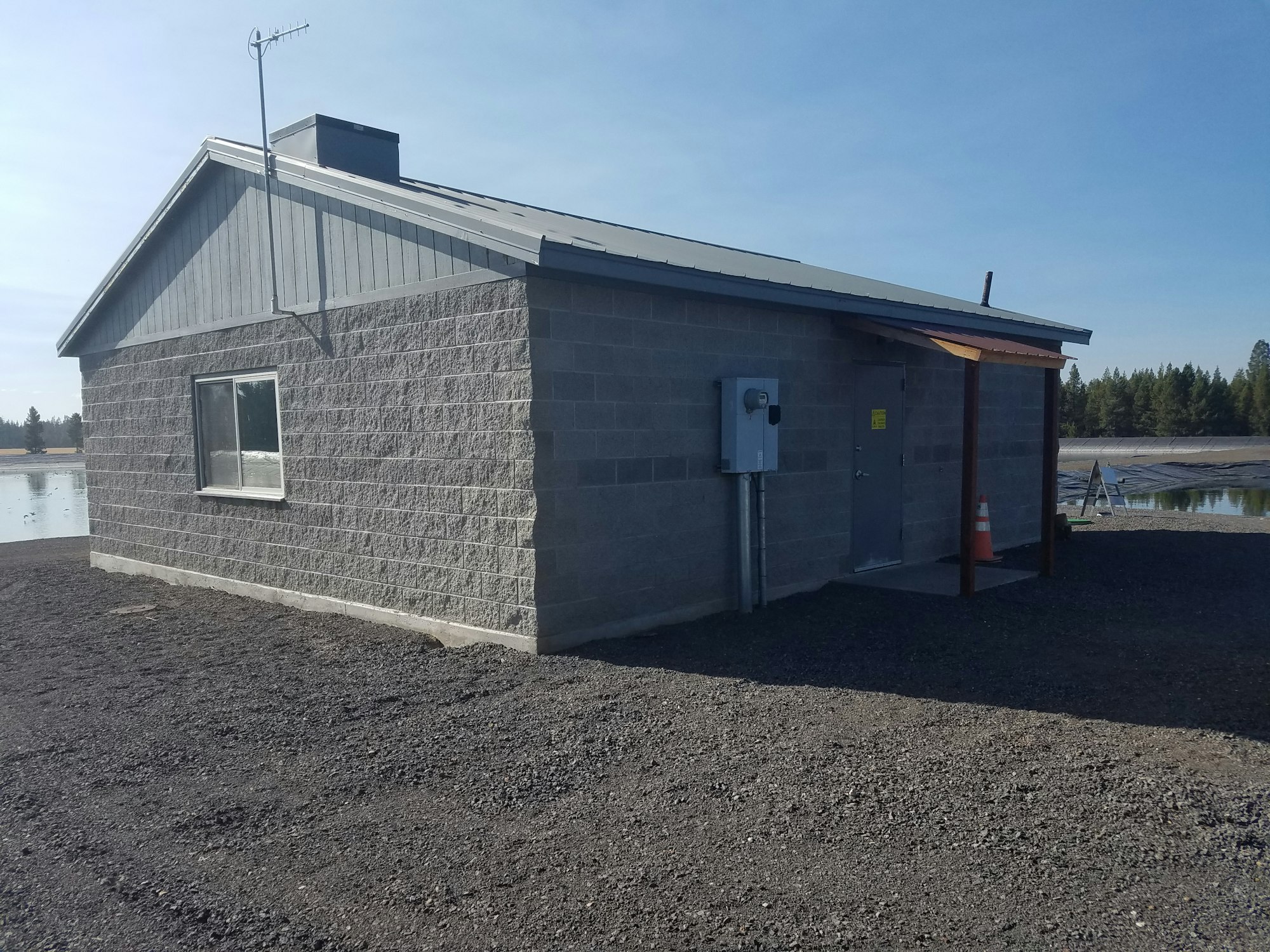
Because so many lots in the subdivision were found to be in areas with high groundwater and unsuitable for onsite systems, and due to restrictions on the siting of such systems, the District began the process in 2002 to upgrade the treatment facility to serve 1,006 lots. The upgraded sewage treatment facility was completed in 2007 and consists of a lagoon system with land irrigation of recycled wastewater. There are currently approximately 907 active connections, with 79 lots remaining to be developed within the service district.
Our primary lagoon has a capacity of 14.42 acre feet, holding approximately 4.7 million gallons of water and equipped with 8 aerators. As part of the new system, the District acquired 480 acres from the U.S. Forest Service. On this property, we constructed 3 lagoons which range in size from 0.9 to 13.5 acres, along with 2 (50) acre irrigation fields planted with orchard grass. To complete these improvements, the District received $4.7 million in Federal Loans and approximately $3.5 million in Grants. The loan is to be paid back in 30 years.
The sewer system operatres using three types types of collection systems, depending on your location: pressure, vacuum, or gravity.
The existing collection system consists of the following: 46,433 linear ft. of vacuum system with 570 connections (2 homes per vacuum pit), 25,875 ft. of the pressure system with 65 connections, 15,840 ft. of 8" gravity sewer system with approximately 267 connections, and 5,200 ft. of force main to the secondary lagoon. The collection system also includes 51 manholes and 5 pump stations.
The vacuum sewers are especially beneficial in locations with subsurface challenges, such as high groundwater tables, unstable soils, or rocky terrain.
Vacuum Sewers - Wastewater from the house flows by gravity into a holding tank (valve pit) located in the utility easement. In most cases, one valve pit will service up to two homes. The vacuum valve will open when enough wastewater has been accumulated. Differential pressure then propels wastewater into the vacuume main. Wastewater travels to the vacuum station through the vacuume main at speeds of 15-18 feet per second, scouring the pipe and preventing blockages. The vacuum main piping is laid in a sawtooth fashion to ensure adequate vacuum levels are maintained at the end of each line.